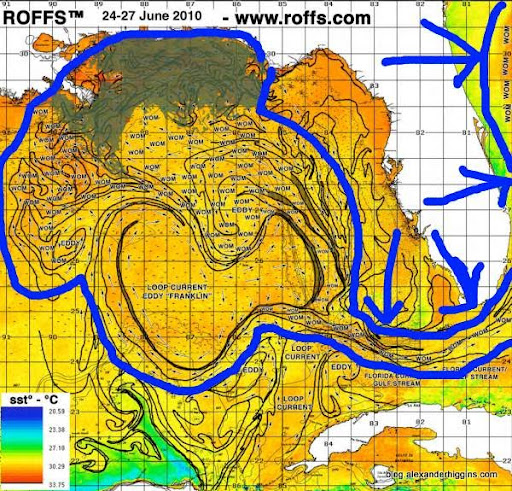
When I last wrote about the last ROFFS independent oil tracking map released on June 22nd it showed a possible mixture of oil and water heading up the entire east coast of Florida.
ROFFS has released an updated map June 28th for June 24-27th which now confirms that the oil from the BP Gulf Oil Spill has indeed made its way up the entire East Coast of Florida.
ROFFS BP Gulf Oil Spill Tracking Map For June 24 to June 27th with WOM (Water Oil Mixture) Outlined
ROFFS uses a combination of techniques to track the oil from the BP Gulf Oil Spill that is available to the public.
It is unacceptable that the Government officials in charge of reporting this to the public are hiding it.
Seafood is being harvested from these waters and women and children are swimming in it while the Government hides that fact that the water is filled with oil and toxic dispersants.

 "Nearly Every Cleanup Worker from Exxon Valdez Now Dead?"http://soitgoesinshreveport.blogspot.com/2010/07/nearly-every-cleanup-worker-from-exxon.html
Greta Perry linked this article from Business Insider on Facebook last night that states nearly every cleanup worker from the Exxon Valdez is now dead. Why? From the fumes? From natural causes? From chemicals? More explanation, please. This prompted me to do some digging today. I read the article, watched the video clip, and my initial reaction was, "Aww c'mon. Hyperbole. Fear mongering by CNN and their 'expert'." It was 21 years ago, to be sure, and are they dead because of the spill? Surely not ALL of them.
Questions.
Are you sure that you want to help clean up the oil spill in the Gulf of Mexico? In a previous article we documented a number of the health dangers from this oil spill that many scientists are warning us of, and now it has been reported on CNN that the vast majority of those who worked to clean up the 1989 Exxon Valdez oil spill in Alaska are now dead. Yes, you read that correctly. Almost all of them are dead.
Merle Savage is one of those that helped cleanup the beaches in 1989 after the Exxon Valdez spill and she is trying to warn the workers in the Gulf and inform them what happened in 1989.. She wrote a book about her experience: Silence in the Sound. Her website is here. Savage explains that her health problems began almost immediately:
After working for 3 days on the oily beaches, I had a persistent cough that developed into bronchitis, headaches, sore throat, upset stomach and fatigue. On the 4th day I reported to the sick bay and was given medication by the doctor who was supplied by VECO, and on the way to my room, I fainted. I had 3 days of bed rest, but went back to work with recurring symptoms. Of the workers that I supervised 80% had the same medical problems. I wonder how many other cleanup workers, like me, went home thinking we would get better – but didn’t? The symptoms escalated until my medical condition took over my life, and was so bad that I have been unable to hold a job.
Savage breathed in crude oil and dispersant for weeks as she and her coworkers cleaned up the beaches that summer. One of the dispersants used that summer was Corexit 9580. Another was Inipol EAP22, also toxic.
The dispersants BP is using today is a variation of the Corexit dispersant used in 1989. They're using Corexit 9500 and 9527. The EPA freely admits that they just don't know about the exact toxicity of them on animals or humans:
It is also important to note that the LC50 value may be different for a given chemical depending on the route of exposure (e.g., skin contact, ingestion, inhalation) and can be different for different animal species, ages and sexes. The LC50 is only one source of toxicity information and only provides information for the species and concentrations of chemical being tested under laboratory conditions. Toxicity tests resulting from controlled laboratory experiments may not accurately represent the degree of toxicity seen in the environment because of factors such as breakdown of the chemical, different species, different routes of exposure, age, sex, stage of development (e.g., adult versus larval).
To protect workers, the EPA advises hazmat gear and masks:
People working with dispersants are strongly advised to use a half face filter mask or an air-supplied breathing apparatus to protect their noses, throats, and lungs, and they should wear nitrile or PVC gloves, coveralls, boots, and chemical splash goggles to keep dispersants off skin and out of their eyes.
BP will provide these upon request.
As of today, BP reports use of more than 1.62 million gallons of dispersant.
Corexit 9527 was used initially in the Gulf but was discontinued because it was considered too toxic. Corexit 9500 is considered much better:
By last week, the EPA and Nalco had both released the ingredient list for COREXIT 9500 in response to widespread public concern. Its constituents include butanedioic acid (a wetting agent in cosmetics), sorbitan (found in everything from baby bath to food), and petroleum distillates in varying proportions—and it decomposes almost entirely in 28 days. "All six [ingredients] are used in day-to-day life—in mouthwash, toothpaste, ice cream, pickles," Ramesh argues. "We believe COREXIT 9500 is very safe."
But, as this Scientific American article points out, all dispersants contain carcinogens. There are reports that Corexit has been banned in the UK but to be clear, it's only been banned in use on rocky shoreline. It may or may not be used elsewhere.
Reports of illness in Louisiana and other Gulf Coast states are beginning to mount. As of June 29:
Exposure to the oil disaster in the Gulf of Mexico has resulted in 162 cases of illnesses reported to the Louisiana state health department, according to a report released Monday. Of those cases, 128 involved workers on oil rigs or individuals involved in the oil spill cleanup efforts, the report said.
And that's just Louisiana. This article in The American Chronicle suggests that the Gulf Oil Syndrome is on the horizon and suggests that many won't be taken seriously:
The Gulf oil spill will likely lead to a new condition known as Gulf Oil Syndrome (GOS), a syndrome of toxicity related to 911, GWS, and MCS, which will initially be denied and labeled as psychiatric to protect the financial interests of responsible parties.
The Exxon medical records were sealed by the courts until 2023 and the Miami Herald reports that long term studies have never been done on the effects of that disaster, so it's difficult for us to know what to expect with this crisis. Last week U.S. Surgeon General Regina Benjamin reiterated this problem:
"Current scientific literature is inconclusive with regard to the potential hazards resulting from the spill," Benjamin said. "Some scientists predict little or no toxic effect ... while other scientists express serious concerns about the potential short-term and long-term impacts the exposure to oil and dispersants could have on the health of responders and our communities."
That lack of published, peer-reviewed study of the Exxon Valdez cleanup workers has made protecting the growing number workers in the Gulf of Mexico all the more difficult and has Alaska watchdogs warning that BP and government regulators are repeating mistakes that made people sick a generation ago.
What are the options? What are the alternatives? Environmentalists would probably suggest that we quit drilling and that would solve all this, but everyone with half a brain knows that's not realistic. Not unless you want to turn back the clock 200 years. I don't have the answers. I don't know how many people died as a result of the Exxon cleanup.
People want to get out there and clean the beaches, the wildlife, and put things back to normal. BP has an obligation to clean up the oil. But at what cost does it all come? The state of Louisiana is already asking BP to set up a fund for mental health help but what about the physical medical needs these clean up workers will be facing? Is that to come from the $20 billion?
And that's the tragedy of the whole episode. That's where you see that this is an end to a way of life on the Gulf coast. Scientists are already predicting a huge dead zone where wildlife cannot survive. Some will say it's all fear mongering and hype and that the Gulf will survive. Everything will be okay. Life goes on. We survive. I sure hope so.
Merle Savage is advising great caution and wants people in the Gulf cleanup to learn from the mistakes of the Exxon Valdez.